If you’re trying to write a mission and vision statement, you may be tempted to start by brainstorming impressive-sounding phrases.
That’s usually where things go wrong.
The best mission and vision statements aren’t marketing slogans. They aren’t corporate buzzwords. And they certainly aren’t something you create simply because a business plan template says you should.
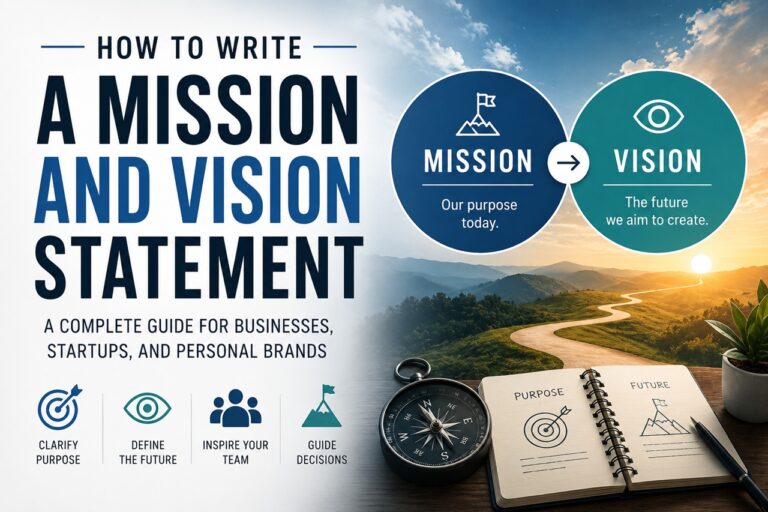
A mission statement explains why your organization exists today. A vision statement describes the future you’re working to create.
Together, they serve as a compass for decision-making, growth, hiring, branding, and strategy.
Whether you’re launching a startup, building an e-commerce brand, leading a nonprofit, or developing a personal brand, learning how to write a meaningful mission and vision can help you stay focused when opportunities, challenges, and distractions inevitably arise.
In this guide, we’ll walk through the strategic thinking behind mission and vision statements, show you how to write them step by step, and share practical examples you can adapt to your own organization.
Why Most Mission and Vision Statements Fail
Let’s start with a hard truth.
Most mission and vision statements are forgettable.
You’ve probably seen examples like:
“To be the leading provider of innovative solutions that deliver excellence and maximize stakeholder value.”
It sounds professional.
It also sounds like it could belong to almost any company on Earth.
The biggest problem isn’t that these statements are poorly written. The problem is that they’re often written for appearance rather than purpose.
A mission and vision should help answer difficult questions:
- Should we launch this product?
- Should we enter this market?
- Should we hire this person?
- Does this opportunity align with our purpose?
- Are we moving toward the future we want to create?
If your mission and vision can’t help guide those decisions, they’re unlikely to be useful.
Great organizations use their mission and vision as strategic tools, not decorative website content.
Mission vs. Vision: The Difference Most People Get Wrong
One of the most common mistakes is treating mission and vision as interchangeable.
They’re related, but they’re not the same thing.
Mission: Why You Exist Today
A mission statement focuses on the present.
It answers questions like:
- What do we do?
- Who do we serve?
- How do we create value?
- Why do we exist right now?
Think of your mission as your organization’s daily purpose.
Vision: The Future You Want to Create
A vision statement focuses on the future.
It answers questions like:
- Where are we going?
- What impact do we want to make?
- What change are we trying to create?
- What does success look like in the long term?
Think of your vision as your destination.
A Simple Analogy
Imagine you’re driving across the country.
Your mission is the vehicle you’re using and the route you’re taking today.
Your vision is the place you’re ultimately trying to reach.
Without a mission, you have no direction.
Without a vision, you have no destination.
You need both.
Before You Write Anything, Answer These Seven Questions
Many people start writing before they’ve done the necessary thinking.
Instead, begin by answering these questions honestly.
1. Why Does Your Organization Exist?
Beyond making money, why are you here?
Revenue matters, but it’s not a mission.
What purpose would remain even if profit disappeared from the equation?
2. What Problem Are You Solving?
Every successful organization solves a problem.
The clearer you are about that problem, the stronger your mission will become.
3. Who Are You Helping?
Be specific.
Trying to serve everyone usually results in serving no one particularly well.
4. What Change Are You Trying to Create?
This question often becomes the foundation of your vision.
Think about the larger impact of your work.
5. What Makes Your Approach Different?
You don’t need to be completely unique, but you should understand what distinguishes your organization.
6. What Values Are Non-Negotiable?
Your mission should align with your core beliefs and principles.
7. What Would Success Look Like Ten Years From Now?
Imagine your organization thriving a decade into the future.
What would you hope to have accomplished?
The answers to these questions provide the raw material for both your mission and vision.
How to Write a Mission Statement Step by Step
Step 1: Focus on Outcomes, Not Products
One mistake I frequently see is businesses defining themselves by what they sell.
For example:
“We manufacture eco-friendly clothing.”
That’s accurate, but it doesn’t explain why the company exists.
Customers rarely connect emotionally with products.
They connect with outcomes.
A stronger version might be:
“We help people make sustainable fashion choices without sacrificing style.”
Notice the difference.
The first describes a product.
The second describes a purpose.
Step 2: Identify Your Audience
Who benefits from your work?
Examples:
- Small business owners
- Busy parents
- College students
- Outdoor enthusiasts
- Local communities
Knowing your audience helps make your mission more specific and meaningful.
Step 3: Clarify the Value You Deliver
Ask yourself:
How are people’s lives better because of your organization?
This answer often becomes the heart of your mission statement.
Step 4: Remove Corporate Jargon
After drafting your statement, remove unnecessary buzzwords.
Words like:
- Innovative
- World-class
- Leading
- Synergy
- Excellence
often add little value.
Plain language is usually more powerful.
Step 5: Keep It Short
Most effective mission statements fit into one or two sentences.
If people can’t remember it, they probably won’t use it.
Mission Statement Examples
Clothing Brand
Mission:
“To create clothing that celebrates culture, craftsmanship, and self-expression while supporting ethical production.”
Coffee Shop
Mission:
“To serve exceptional coffee and create a welcoming space where people feel connected.”
Digital Marketing Agency
Mission:
“To help small businesses grow through practical, transparent marketing strategies.”
Nonprofit
Mission:
“To provide underserved communities with access to quality education and life-changing opportunities.”
Each statement clearly identifies purpose, audience, and value.
How to Write a Vision Statement Step by Step
Once your mission is clear, writing a vision becomes much easier.
Step 1: Imagine the Future
Picture your organization succeeding beyond your expectations.
Now ask:
What changed because we existed?
The answer often reveals your vision.
Step 2: Focus on Impact, Not Status
Many organizations make the mistake of writing visions focused on size.
For example:
“To become the largest company in our industry.”
That’s a business objective, not a vision.
A stronger vision focuses on impact:
“To make sustainable fashion accessible to everyone.”
The second statement creates meaning beyond growth.
Step 3: Be Ambitious
A vision should stretch your imagination.
It should inspire people.
If it feels completely safe, it may not be ambitious enough.
Step 4: Stay Grounded in Reality
At the same time, avoid impossible fantasies.
People should believe the future you’re describing is achievable.
Vision Statement Examples
Sustainable Fashion Brand
Vision:
“A future where ethical fashion becomes the standard rather than the exception.”
Education Company
Vision:
“A world where every learner has access to affordable, high-quality education.”
Healthcare Startup
Vision:
“To create a future where preventive healthcare is accessible to every family.”
Personal Brand
Vision:
“To help millions of entrepreneurs build businesses aligned with their values.”
These visions focus on transformation rather than company size.
How Mission, Vision, Values, and Goals Work Together
One reason organizations struggle with mission and vision is that they confuse them with values and goals.
Here’s an easy way to understand the difference:
| Element | Purpose |
|---|---|
| Mission | Why you exist today |
| Vision | The future you want to create |
| Values | The principles guiding your behavior |
| Goals | Specific outcomes you want to achieve |
For example:
Mission:
Help entrepreneurs grow online.
Vision:
A future where anyone can build a thriving digital business.
Values:
Transparency, creativity, continuous learning.
Goal:
Reach 100,000 customers within five years.
Each serves a different role.
Examples for Different Types of Organizations
Startup
Mission:
“To simplify project management for growing teams.”
Vision:
“A future where collaboration feels effortless for every organization.”
E-Commerce Brand
Mission:
“To offer thoughtfully designed products that improve everyday life.”
Vision:
“To make intentional living more accessible around the world.”
Personal Brand
Mission:
“I help aspiring creators build sustainable online businesses.”
Vision:
“To empower a new generation of independent entrepreneurs.”
Nonprofit Organization
Mission:
“To connect underserved students with educational resources and mentorship.”
Vision:
“A world where every child has the opportunity to reach their potential.”
How Often Should You Update Your Mission and Vision?
Not every year.
Mission and vision should remain relatively stable.
However, they aren’t carved in stone.
You should revisit them when:
- Your business model changes significantly
- Your audience changes
- Your organization expands into a new direction
- Your purpose evolves
Many successful companies refine their statements as they grow.
What’s important is maintaining alignment between your current reality and your stated purpose.
A Simple Mission and Vision Worksheet
If you’re struggling to start, complete these sentences.
Mission
We help __________
achieve __________
through __________.
Example:
We help small businesses achieve sustainable growth through practical marketing solutions.
Vision
We envision a future where __________.
Example:
We envision a future where every entrepreneur has access to the tools needed to succeed.
This simple exercise often produces surprisingly effective first drafts.
Final Thoughts
Writing a mission and vision statement isn’t about finding the most impressive words.
It’s about gaining clarity.
A strong mission explains why your organization exists today. A compelling vision describes the future you’re working toward. Together, they help guide decisions, inspire teams, strengthen culture, and communicate purpose.
The best mission and vision statements aren’t written for investors, consultants, or website visitors. They’re written for the people who need a clear understanding of why the organization exists and where it’s headed.
If you’re starting from scratch, don’t chase perfection. Focus on honesty, clarity, and purpose. You can refine the wording later.
What matters most is creating statements that genuinely reflect who you are, who you serve, and the future you’re trying to build.
When those elements come together, a mission and vision become far more than business exercises—they become the foundation of everything that follows.