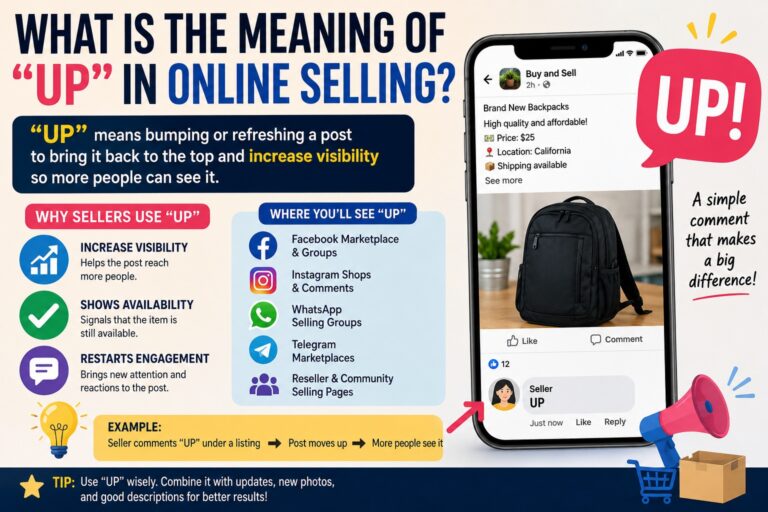
If you’ve spent time browsing Facebook Marketplace, Instagram shops, WhatsApp selling groups, or online reseller communities, chances are you’ve seen someone comment simply:
“UP”
At first glance, it can feel confusing. Is it shorthand? A typo? A secret selling code?
In online selling, “UP” is commonly used to bump a product listing, post, or comment back into visibility so more people can see it. It’s a quick way for sellers — and sometimes buyers — to increase engagement and keep a product active in crowded online marketplaces.
While the word itself is short, it plays a surprisingly important role in social-media-based selling.
Let’s break down exactly what “UP” means, why people use it, how it works, and whether it still matters today.
What Does “UP” Mean in Online Selling?
In online selling, “UP” usually means:
- Bringing a post back to the top
- Increasing visibility
- Refreshing engagement
- Making a listing appear active again
You’ll often see it in comment sections under product listings.
For example:
Seller posts a handbag for sale
A few hours later, the seller comments: “UP”
That small comment can push the listing higher in certain group feeds or notify members that the item is still available.
In simple terms, it’s basically a digital version of saying:
“Hey, this item is still here — take another look.”
Why Do Sellers Comment “UP”?
Online marketplaces move fast.
Hundreds — sometimes thousands — of new posts appear every day. Without engagement, older listings quickly disappear beneath newer ones.
That’s why sellers use “UP.”
Main Reasons Sellers Use “UP”
1. To Increase Visibility
The biggest reason is exposure.
An “UP” comment can help bring attention back to a product that people may have missed earlier.
This is especially common in:
- Facebook selling groups
- Buy-and-sell communities
- Live selling sessions
- Local marketplace groups
2. To Signal That the Item Is Still Available
Sometimes buyers assume older posts are already sold.
By commenting “UP,” the seller indirectly says:
“This product is still available.”
3. To Restart Engagement
Engagement matters on social platforms.
Comments, reactions, and interactions can help a post stay active within platform algorithms.
Some sellers intentionally use “UP” to spark renewed activity.
Where Is “UP” Commonly Used?
The term is especially popular in social-commerce communities rather than traditional eCommerce websites.
You’ll commonly find it on:
- Facebook Marketplace
- Facebook buy-and-sell groups
- Instagram comment selling
- WhatsApp selling groups
- Telegram marketplaces
- Community reseller pages
Interestingly, “UP” is much more common in Asian online selling communities, including the Philippines and parts of Southeast Asia, but it’s also understood in many U.S.-based reseller groups.
Does “UP” Actually Work?
Sometimes yes — but not always.
Years ago, commenting “UP” could significantly move a post higher in group feeds. Today, social media algorithms are much more advanced.
Platforms like Facebook Marketplace and Instagram now prioritize multiple engagement factors, including:
- Relevance
- User interaction
- Freshness
- Click-through activity
- Watch time
- Messaging activity
So while “UP” may still help in certain groups, it’s no longer a guaranteed visibility trick everywhere.
That said, many sellers continue using it because:
- It’s simple
- It costs nothing
- It occasionally improves exposure
- Buyers recognize the meaning instantly
Other Similar Terms Used in Online Selling
“UP” is not the only shorthand term used by online sellers.
Here are some other common marketplace expressions:
PM
“PM” means “private message.”
Example:
PM me for price.
HM
“HM” means “how much.”
Buyers often comment this when pricing is unclear.
LP
“LP” means “last price.”
Buyers use this when negotiating.
Mine
When someone comments “Mine,” they’re claiming the product and expressing intent to buy.
Sold
This indicates the product is no longer available.
Online selling communities often develop their own mini-language over time.
Is “UP” Considered Spam?
It depends on how often it’s used.
Occasional bumping is usually acceptable in selling groups. But excessive “UP” comments can annoy users and violate group rules.
Some Facebook groups even have posting policies like:
- Only one “UP” every 24 hours
- No excessive bumping
- No spam comments
Overusing it can actually hurt your credibility.
Personally, I think strategic updates work better than repetitive “UP” comments.
For example, instead of typing only “UP,” sellers can add useful updates like:
- “Still available”
- “Price reduced today”
- “Free shipping added”
- “New photos uploaded”
Those comments provide real value while also refreshing engagement.
Better Alternatives to Simply Commenting “UP”
Modern online selling is becoming more competitive, so sellers often need smarter visibility strategies.
Here are some better alternatives:
Update Product Photos
Fresh images often improve engagement immediately.
Rewrite the Product Description
A clearer title or better keywords can help buyers discover the listing more easily.
Offer Limited-Time Discounts
Even small promotions can increase urgency.
Reply Quickly to Comments
Fast response times improve buyer trust.
Use Better Keywords
Search-friendly titles matter more than many sellers realize.
For example:
Bad title:
Shoes for Sale
Better title:
Men’s Nike Running Shoes Size 10 – Like New
The Psychology Behind “UP”
Interestingly, “UP” works partly because of human psychology.
People are naturally curious when they see active discussions or comments on a listing.
Even a small interaction can create the impression that:
- The item is popular
- Others are interested
- The product is still active
This subtle social proof can sometimes encourage more clicks and inquiries.
Should You Use “UP” in Your Own Online Selling?
You can — but use it wisely.
I’d recommend using “UP” sparingly and combining it with more meaningful engagement tactics.
Instead of repeatedly typing “UP,” try:
- Adding new product details
- Posting customer feedback
- Updating pricing
- Sharing product benefits
- Improving visuals
That approach usually feels more professional and attracts better-quality buyers.
Final Thoughts
So, what is the meaning of “UP” in online selling?
In simple terms, it’s a way to bump or refresh a product listing so it gains more visibility and attention in online marketplaces and selling groups.
While the technique has been around for years, its effectiveness now depends heavily on the platform, algorithm, and how sellers use it.
Still, “UP” remains part of the culture of online selling — especially in social-media-based marketplaces where visibility changes quickly.
And honestly, even though it’s only two letters, almost every experienced online seller recognizes exactly what it means the moment they see it.