If you’ve ever watched a dog stare into your soul, a crow solve a puzzle, or an octopus escape a closed jar like a tiny underwater Houdini, you’ve probably wondered:
Are animals conscious?
Do they think?
Do they feel?
Do they know they exist?
This question has been debated for centuries, but modern science has reached some surprisingly clear—and surprisingly fascinating—conclusions. Spoiler: animals may understand much more than we once believed.
In this article, you’ll learn what consciousness means in humans, how animal consciousness fits in, how scientists test awareness, which animals show the strongest signs of consciousness, and what all this says about our place in the natural world.
Are Animals Conscious? The Simple, Direct Answer
Let’s start with the big question:
Yes—most scientists today agree that animals are conscious in some form.
That doesn’t mean their consciousness is identical to ours.
But they:
- feel pain
- experience emotions
- recognize danger
- make choices
- learn from experience
- display curiosity
- sometimes even show self-awareness
In 2012, a group of leading neuroscientists signed The Cambridge Declaration on Consciousness, stating:
“The evidence indicates that humans are not unique in possessing the neurological substrates that generate consciousness.”
In plain English:
Animals have the brain structures needed for conscious experience.
Now let’s break down what that means.
What Is Consciousness (And How Do We Apply It to Animals)?
Before we compare human consciousness and animal consciousness, we need to understand what consciousness means.
In its simplest form:
Consciousness is awareness.
Awareness of:
- the environment
- sensations
- emotions
- needs
- choices
- intentions
Humans have a higher-level consciousness that includes:
- self-reflection
- long-term planning
- language
- imagination
- moral reasoning
But animals share many foundational forms of awareness.
Scientists often break consciousness into parts:
1. Primary consciousness
Basic awareness of sensations and surroundings.
Most animals have this.
2. Affective consciousness
Ability to feel emotions and moods.
Mammals and birds clearly show this.
3. Self-consciousness
Recognizing yourself as “you.”
Only a few species have passed this test so far.
4. Higher-order thinking
Analyzing thoughts, building narratives, having a sense of past and future.
This is where humans excel.
With that framework, let’s explore what animals can actually do.
How Scientists Test Animal Consciousness
Since your cat can’t sit down and tell you about its childhood trauma, scientists rely on indirect tests. Here are the most common ones:
1. The Mirror Self-Recognition Test
This tests whether an animal recognizes itself in a mirror.
Animals that pass usually:
- touch a spot on their forehead that only the mirror reveals
- investigate the marked area on themselves, not the mirror
Animals that pass:
- Great apes (chimps, bonobos, orangutans)
- Dolphins
- Orcas
- Elephants
- Some magpies
- Possibly some species of fish
Notably, many animals fail this test not because they’re “not conscious,” but because they don’t rely on sight the way humans do.
Dogs smell the world, so mirrors aren’t very meaningful to them.
2. Problem-Solving and Tool Use
Animals that use tools show awareness and intention.
Examples:
- Crows bend wires into hooks
- Octopuses carry coconut shells as mobile homes
- Sea otters use rocks to crack open shells
- Chimps use sticks to fish for termites
This shows:
- planning
- memory
- foresight
- cause-and-effect understanding
3. Emotional Awareness
Animals show clear signs of emotion, such as:
- joy
- fear
- jealousy
- grief
- affection
- frustration
- excitement
Elephants have funeral rituals,
Dolphins help injured pod members,
Dogs get jealous when their owners pet another dog.
Emotions are a strong indicator of consciousness.
4. Behavioral Flexibility
Animals that change behavior based on context demonstrate awareness.
For example:
- Parrots learn new tricks after watching humans
- Rats wait longer for a bigger reward, showing impulse control
- Wolves adapt pack behavior to different situations
- Bees communicate the location of food through the waggle dance
Rigid behavior = instinct
Flexible behavior = awareness
How Does Animal Consciousness Compare to Human Consciousness?
Humans have the most complex form of consciousness known, but animals share many of its building blocks.
Here’s a friendly breakdown:
Animals have:
- Sensory awareness
- Emotional experience
- Memory
- Choice-making
- Social understanding
- Pain and pleasure perception
- Basic self-awareness (in many species)
Humans have:
- Advanced self-awareness
- Reflective thinking
- Narrative-building
- Language
- Abstract reasoning
- Moral understanding
- Creativity and imagination
- Meta-consciousness (“awareness of our awareness”)
Animals don’t need to talk about existential dread or write novels to demonstrate consciousness. They show it through behavior, emotions, and cognition.
Think of consciousness as a spectrum—not a ladder with humans on top and everyone else below.
Animals That Show Strong Signs of Consciousness
Let’s look at what science says about some specific species.
1. Primates
Chimpanzees, bonobos, orangutans, and gorillas show:
- self-awareness
- empathy
- tool use
- long-term planning
- communication systems
Their brains are structurally similar to ours.
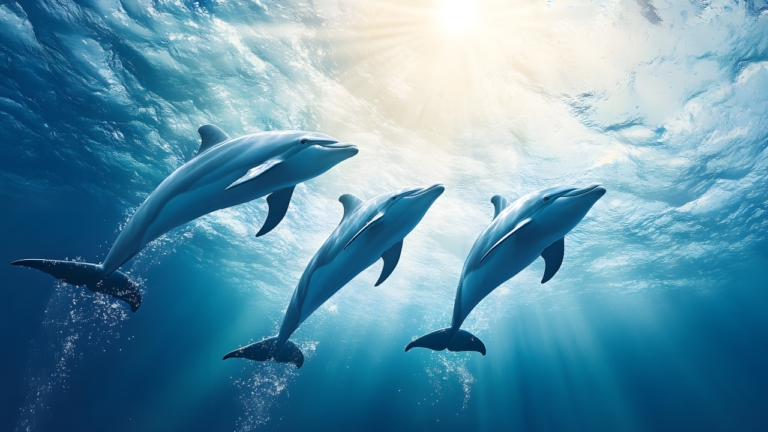
2. Dolphins and Whales
These animals have:
- large, complex brains
- advanced social structures
- unique vocalizations
- self-recognition in mirrors
- problem-solving ability
Some researchers believe dolphin consciousness may rival human consciousness in complexity—differently organized, but just as rich.
3. Elephants
Elephants display:
- empathy
- grief rituals
- cooperation
- memory
- self-recognition
Their emotional intelligence is exceptional.
4. Birds (especially crows and parrots)
Crows can solve puzzles that require multi-step reasoning.
Parrots understand concepts like shape, color, and numbers.
Some scientists say corvid intelligence equals that of a 5-year-old child.
5. Octopuses
They’re like aliens on Earth.
Their consciousness is distributed across their arms, each with its own neural system.
They:
- escape tanks
- open jars
- play
- solve mazes
- recognize individual humans
Even more fascinating: octopus intelligence evolved separately from ours.
6. Dogs and Cats
Maybe not as cognitively complex as dolphins or crows, but dogs and cats clearly have:
- emotional awareness
- social understanding
- memory
- problem-solving skills
Dogs can read human emotions unusually well.
Cats… have selective participation, but still demonstrate awareness and intention.
Do All Animals Have Consciousness?
This depends on how we define consciousness.
Insects and simple organisms
They show:
- memory
- learning
- navigation
- communication
Bees, for example, can solve puzzles and plan routes.
Ants can coordinate large-scale activities.
Some scientists argue that insects have very basic consciousness, while others disagree. The debate continues.
Fish
While many people assume fish lack consciousness, studies show they:
- feel pain
- learn patterns
- recognize individuals
- have social structures
- display fear and stress responses
Reptiles
Reptiles were once thought to be “instinct machines,” but newer research shows:
- play behavior in lizards
- problem-solving ability
- social awareness in some species
Consciousness in animals is likely widespread—even if it looks different across species.
Why Animal Consciousness Matters
Understanding animal consciousness changes how we:
- treat animals
- shape animal welfare laws
- design habitats
- approach research and education
- understand our place in evolution
It also reminds us that humans are not separate from nature—we are part of it.
Animals are not biological robots.
They feel.
They think.
They choose.
They suffer.
They play.
They connect.
And that’s consciousness in action.
Final Takeaway
So, are animals conscious?
Yes—overwhelming scientific evidence says they are.
Their consciousness may differ from ours, but it is absolutely real, meaningful, and measurable.
From dolphins to crows to octopuses to elephants—even to bees—animals experience the world in rich and varied ways. Animal consciousness is a spectrum, not a simple yes/no question.
Understanding animal awareness doesn’t make humans less special.
It makes the world more magical.